For a U.S. import program, the best sourcing country is not automatically the largest shoe manufacturing country or the lowest quoted-cost location. Choose the country and supplier combination that fits the product, communicates clearly during development, provides traceable quality records, and supports the required import process. For finished footwear context, see Finished Footwear Sourcing for Importers.
Start with the product and approval route, then compare relevant locations against the same buyer brief. Use current U.S. import data as a screening tool, not as proof that every supplier in a country can make your product. The International Trade Administration’s U.S. footwear import statistics by country can help identify market patterns, while supplier-level documents must support the final decision.
Answer the Core Buyer Question
Country selection matters, but supplier capability matters more at the quotation and development stage. A location with strong footwear output may still be unsuitable if the supplier cannot match the outsole construction, size range, materials, testing plan, packaging, or communication process your U.S. program needs.
Compare each candidate using one controlled brief. Record the source and date for country-level data, and ask each supplier for comparable commercial and technical information. The table below provides a practical comparison structure.
| Decision area | What to compare | Buyer proof to request | Why it changes the decision |
|---|---|---|---|
| Product fit | Relevant footwear type, outsole material, construction, size range and decoration | Technical review, material information, sample route and comparable references | Capability for your product is more useful than national production volume |
| Development support | Artwork handling, mould route, sample revisions, approval records and communication ownership | Development workflow, sample record and named project contact | Clear ownership reduces errors between brief, sample and production release |
| Order requirements | Quantity basis, size mix, colour or compound minimums, tooling and packaging scope | Like-for-like quotation with assumptions listed | A low unit quote may exclude tooling, testing, freight or packaging |
| Quality controls | Incoming material checks, in-process controls, final inspection and deviation handling | Inspection plan, sample measurements, reports and release records | Repeatable records make defects easier to detect and correct |
| Documentation | Commercial invoice, packing information, marking, product records and required compliance files | Document list matched to the product and destination | Missing or inconsistent information can delay customs or retail approval |
| Logistics | Transport route, shipment responsibility, packaging dimensions and schedule dependencies | Incoterm, packing basis, dispatch assumptions and milestone plan | Transit and handoff risks affect usable delivery timing |
| Trade considerations | Classification, applicable duties, origin rules and agreement eligibility | Broker or qualified customs review using current product facts | Legal origin is not determined only by the shipping country |
For documentation, use current U.S. import requirements and documentation guidance alongside advice from the importer’s customs broker. Trade-agreement eligibility also needs current checking under the relevant footwear provisions in U.S. free trade agreements. WENCHANG can organize artwork, samples, production updates, inspection and shipment tracking, but the importer remains responsible for customs declarations and legal compliance.
Define the Product and Application Inputs
Before comparing countries, define what the supplier must make and what the U.S. buyer must accept. A complete footwear brief normally includes the style, upper, lining, insole, outsole, last or fit reference, size run, colours, branding, packaging, quantity, destination and required tests.
For an outsole or component program, add the controlled drawing or physical reference, material or compound, layer construction, contact surface, bonding interface, dimensions, tolerances, artwork, printing, cutting and edge treatment. Do not use generic thickness, hardness, density or weight assumptions. Link each value to the material grade, measurement method and approved sample.
Buyer Input Brief
- Application: State the footwear type, user conditions, market and intended use.
- Construction: Identify the outsole layers, upper interface, bonding method and visible contact surface.
- Commercial basis: State pieces versus pairs, size mix, colours, quantity, packaging, destination and trade term.
- Approval basis: Provide drawings, artwork, physical references, tolerances, tests and acceptance limits.
- Document control: Keep each drawing, artwork file, specification and physical sample tied to its own identifier, revision and approval date. Use one release log to show which versions were approved together.
This input prevents suppliers from pricing different products under the same description. It also gives WENCHANG a basis for checking the mould route, sample scope, inspection points and open actions before production release.
Compare the Relevant Options and Trade-Offs
Do not compare countries using unit price alone. Compare the total decision: product suitability, communication effort, order flexibility, quality visibility, document readiness, transport exposure and trade treatment. A supplier that needs fewer corrective rounds may be commercially stronger even when its initial quotation is not the lowest.
Normalize every quotation before ranking it. Separate tooling, development, testing, packaging, freight, duty and tax responsibility, payment terms, defect or rework assumptions, and usable yield. State whether quantities mean individual pieces or pairs. Keep supplier quotation, customs value and landed cost as separate figures.
Hypothetical Buyer Scenario 1: Custom Lifestyle Sneaker
Situation: A U.S. brand needs a new mould, several outsole colours, branded artwork and a defined size run. The brand has a tech pack, but no approved outsole sample or test protocol.
Evidence gap: Country-level import activity does not prove that shortlisted suppliers can manage artwork revisions, mould development or the required outsole tests.
Trade-off and decision: The buyer should favor the supplier with the clearer development record and sample approval route, even if another location offers a lower preliminary unit quote. The next action is to issue the drawing, artwork, size range, material brief and acceptance checklist, then compare revised quotations on the same basis.
Hypothetical Buyer Scenario 2: Replenishment Work Shoe
Situation: A distributor needs repeat orders for an existing style, with stable colours, established packaging and predictable replenishment.
Evidence gap: The buyer has historical sales data but has not separated manufacturing price from freight, duty, inspection and delivery variability.
Trade-off and decision: A location with a reliable approved-sample process and documented shipment milestones may reduce supply-chain risk, even without a proven tariff advantage. The buyer should compare the complete landed-cost assumptions, inspect a current production sample, and request a replenishment plan tied to the approved specification.
For either scenario, keep comments tied to the exact sample and document versions reviewed. WENCHANG’s sample process can support appearance, dimensions, material, mass, packaging fit and deviation decisions, while the buyer sets the acceptance criteria and gives the release approval. The Four-Stage Footwear Inspection Process provides a useful structure for organizing quality records.
Plan Samples, Tests and Quality Checks
A country comparison becomes useful only when the selected supplier can produce an approved product consistently. Plan the approval route before comparing final quotations. The buyer owns the acceptance criteria, while the supplier provides samples, measurements, production information and available test records.
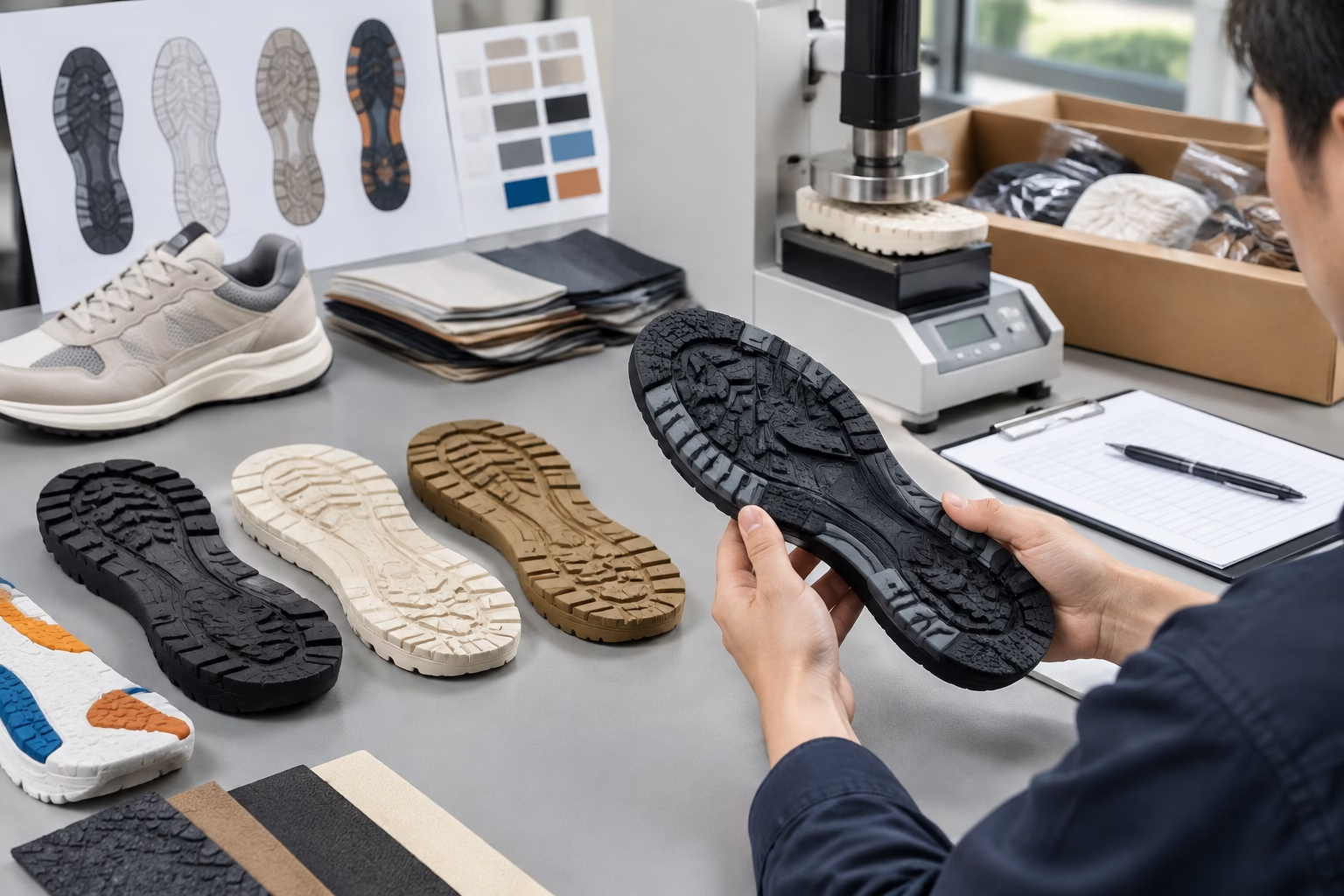
Start with one controlled reference package. Include the drawing, artwork, material or compound description, colour references, size range, packaging brief and intended application. A controlled reference means the team can identify exactly which version was sampled and approved. Each drawing, artwork file, physical sample and packaging brief may have its own identifier, revision and approval date.
Keep comments tied to the exact sample and document versions examined together. A single release log should cross-reference the versions reviewed and approved as a group. This prevents a later quotation, mould adjustment or production batch from being judged against an older drawing.
Sample Approval Checklist for Footwear Buyers
- Appearance: Check colour, surface finish, logo placement, mould detail, flash, marks and visible defects under agreed lighting.
- Dimensions: Measure critical features against the drawing, including length, width, height, tread details and fit-related interfaces.
- Material: Record the specified material or grade, colour or compound, and any approved substitute conditions.
- Mass: Weigh the defined sample and state whether the result covers one piece or one pair.
- Size range: Identify which sizes were sampled and how grading across the full range will be controlled.
- Function: Assign applicable checks for flex, abrasion, slip, bonding, fit or whole-shoe performance.
- Packaging: Check protection, labelling, carton fit, size separation and the quantity basis used for packing.
- Deviation decision: Record whether each difference is accepted, corrected, retested or rejected.
- Approval ownership: Name the buyer or authorized party who releases the sample for production.
Testing must match the product risk and the destination market. A supplier report can support a decision, but the buyer needs the method, specimen, conditioning, unit and result status. “Pass” without that context is difficult to compare across suppliers. Separate a buyer target from a measured result, and identify any supplier-grade value as informational rather than universal.
WENCHANG’s Footwear Sample Development and Approval route can organize appearance, dimensions, material, mass, size, test and deviation records. The acceptance limit still comes from the buyer’s drawing, approved sample, test method and market obligations. Published route timing depends on the mould path and confirmed scope, so it is not a universal production promise.
Quality Records to Request Before Release
Ask for the current sample record, measurement sheet, material information, applicable laboratory reports, packaging details and open-deviation list. For bulk production, add the inspection plan, production status, packing confirmation and shipment documents. The buyer or appointed inspector decides whether the lot meets the approved basis.
This structure also helps compare suppliers in different shoe manufacturing countries. One factory may provide attractive development support, while another may offer stronger documentation or a clearer inspection handoff. Country-level reputation cannot replace product-specific records.
Prepare the RFQ and Next Action
A comparable quotation begins with comparable inputs. Send every shortlisted supplier the same commercial and technical brief, then list assumptions separately. This prevents one quote from including mould work or testing while another covers only the unit price.
RFQ Input Checklist for a U.S. Import Program
- Product boundary: State whether the request covers finished footwear, outsoles, components or development services.
- Technical references: Attach the controlled drawing, artwork, BOM, material brief, physical reference and construction notes.
- Application: Describe the user, footwear category, intended conditions and any important fit or function concern.
- Size and colour: List the size run, grading basis, colourways, branding and required approval samples.
- Quantity basis: Separate pieces from pairs, sample quantities from bulk quantities, and forecast demand from a firm order.
- Tooling: State whether an existing mould, new mould, size mould set or tooling modification is expected.
- Quality: Attach acceptance criteria, tolerances, test methods, inspection points and deviation rules.
- Packaging: Define individual packing, carton requirements, labels, marks, pallet needs and package quantity.
- Commercial basis: Request unit basis, tooling, development, testing, minimum colour or compound conditions, payment terms and defect or rework assumptions.
- Logistics: Give destination, requested trade term, transport expectations and whether freight, duty or tax is excluded.
- Timing: Identify the desired sample, approval, production and shipment milestones, including buyer review time.
- Open questions: Ask the supplier to list exclusions, substitutions, technical risks and information still needed.
For each quotation, build a comparison sheet with the same rows. Separate supplier price from customs value and total landed cost. Landed cost may include freight, duty, taxes, inspection, brokerage, packaging changes, rework and delivery variability. The importer remains responsible for customs classification, origin analysis and final import compliance with its broker or qualified advisor.
Send the complete package through a Request a Quote enquiry and ask the supplier to return assumptions with the quotation. The practical next action is to select one controlled reference set, define the acceptance checklist, request sample and test planning, and compare revised offers on the same commercial basis.
For relevant company and manufacturing context, see Export Supply Experience and Markets.
Frequently Asked Questions
Should a U.S. importer choose a country before choosing a supplier?
No. Use country-level data for initial screening, then compare individual suppliers by product fit, communication, quality records, documentation, logistics and commercial clarity.
What sample should a footwear buyer approve?
Approve a sample that represents the intended material, colour, size, construction and packaging basis. Record measurements, applicable tests, deviations and the responsible release decision.
How can buyers compare footwear supplier quotations fairly?
Issue the same drawing, size range, quantities, test plan, packaging brief, destination and trade assumptions. Separate unit price, tooling, testing, freight, duty, taxes and other landed-cost items.
Who is responsible for U.S. import documentation and customs decisions?
The importer remains responsible for accurate classification, origin, entry documentation and applicable compliance decisions. The supplier can provide commercial and product information, but a broker or qualified advisor may be needed.